You visit a website and, before anything loads, it asks you to confirm your age. That moment can feel confusing, or even a bit uncomfortable. You might wonder why a site needs this information just to let you in.
Age verification is not random or pointless. This article explains why some sites require it, what purpose it serves, and how it affects users in a simple and clear way.
What Is Age Verification on Websites?
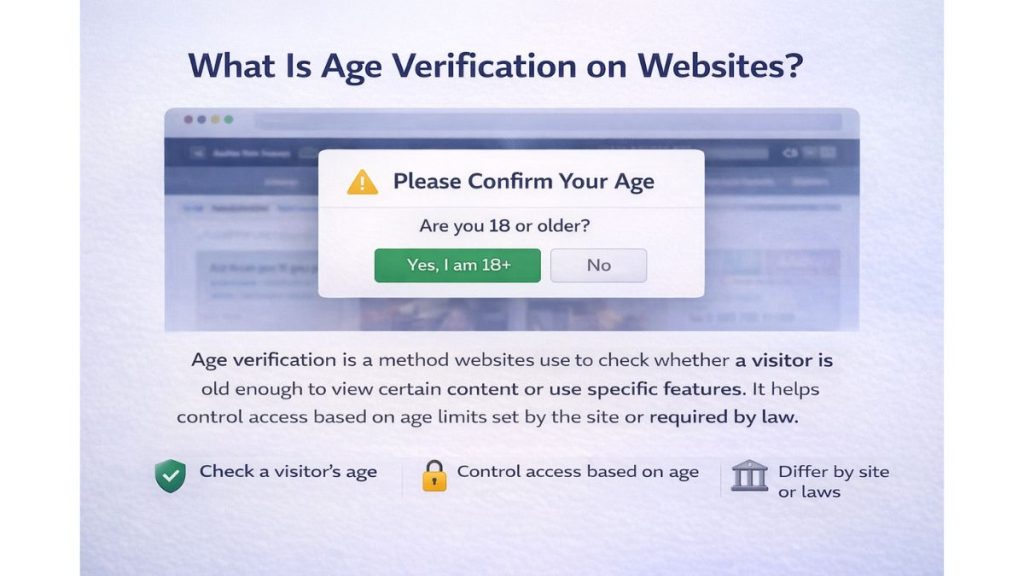
Age verification is a method websites use to check whether a visitor is old enough to view certain content or use specific features. It helps control access based on age limits set by the site or required by law. The process exists to reduce exposure to content meant only for adults.
You often see age checks when opening a site for the first time, signing up for an account, or clicking on restricted sections. The method can be basic or more detailed, depending on the site.
Why Websites Ask for Age Verification?
Websites do not ask for age without a reason. In most cases, it is done to meet legal, ethical, or safety needs.
- To comply with child protection laws
- To prevent minors from accessing adult material
- To meet industry or platform rules
- To reduce legal responsibility
- To show responsible content control
These reasons apply across many types of online platforms.
Types of Websites That Require Age Verification
Only certain websites usually require age verification. These sites often deal with content that is restricted by age.
- Adult content platforms
- Gambling and betting websites
- Alcohol and tobacco online stores
- Some social media platforms
- Streaming services with mature shows
- Online games with age ratings
These categories are closely monitored by regulators in many countries.
Legal Reasons Behind Age Verification
Many governments require websites to take steps to protect children online. Laws focus on limiting access to harmful or adult material. While the rules vary by country, the general goal stays the same.
To avoid breaking these laws, websites add age verification as a safety step. Some platforms apply it to all users to avoid regional confusion and legal risk.
How Age Verification Usually Works?
The way age verification works depends on the level of restriction needed.
- Clicking a button to confirm age
- Entering a birth date
- Creating an account with age details
- Uploading identification for strict checks
- Using third-party verification services
Most sites choose the simplest method that still meets their requirements.
Privacy and Data Safety Concerns
Many people worry about privacy when asked for personal details. This concern is understandable, and trusted websites try to limit data use.
- Only basic information is requested
- Data is often encrypted and protected
- Some checks do not store personal details
- Reputable sites follow data protection laws
Still, users should be careful when sharing information on unknown sites.
What Happens If You Don’t Pass Age Verification?
If you do not meet the age requirement, the site usually blocks access. This is done automatically and without personal judgment.
You may be redirected away, prevented from creating an account, or restricted from certain features. The site does this to stay compliant and protect users.
Common Misunderstandings About Age Verification
There are several common myths around age checks online.
- Not all websites require age verification
- It is not always used for tracking
- Rules differ by country and platform
- Age checks are required for restricted content
- It is not optional on certain sites
Knowing this helps reduce confusion when browsing online.
Conclusion
Some sites need age verification to protect minors, follow laws, and act responsibly online. It helps control access to content that is not suitable for everyone. While it may feel inconvenient, it serves an important safety purpose.
Understanding why age verification exists makes online browsing less frustrating. If this article helped you, feel free to share it or leave a comment with your thoughts.
Published on January 20, 2026 under .
